

How Engineers Build Repeatability Into Safety-Critical Fastening Processes
November 19.2025 | Essential Applications
Consistency defines safety. In automotive systems like airbag modules and steering assemblies, even a small variation in clamp installation can affect long-term reliability and compliance. For engineers and sourcing managers, the challenge is creating fastening processes that deliver repeatable results every time, across every production shift and line.
Why Repeatability Matters in Safety Systems
Repeatability is the foundation of product integrity. In airbag modules, for instance, a clamp must maintain a precise level of tension to contain deployment forces safely. Too tight, and the material may deform over time. Too loose, and the module could fail during deployment.
The same applies to steering racks, where uniform clamp force is required to maintain system responsiveness and durability under load. When tools perform inconsistently or torque values vary between stations, it puts the entire validation process at risk. Meeting IATF 16949 standards requires every clamp to be installed within specification – not just during testing, but on the production floor.
Challenges Engineers Face on the Line
Engineers know that maintaining repeatability in fastening is not simple. Variations can come from tool wear, operator fatigue, environmental factors or even inconsistent calibration schedules. Each of these variables can introduce small errors that accumulate across thousands of assemblies.
Meanwhile, sourcing managers are balancing the need for accuracy with cost, space constraints, and reliable IATF certified suppliers. Many facilities still rely on setups that take up valuable space, require additional power and increase maintenance overhead.
How Tool Control Builds Process Consistency
To maintain repeatability, engineers are using high volume production tools. This approach ensures every installation follows the same torque, speed and closure pattern.
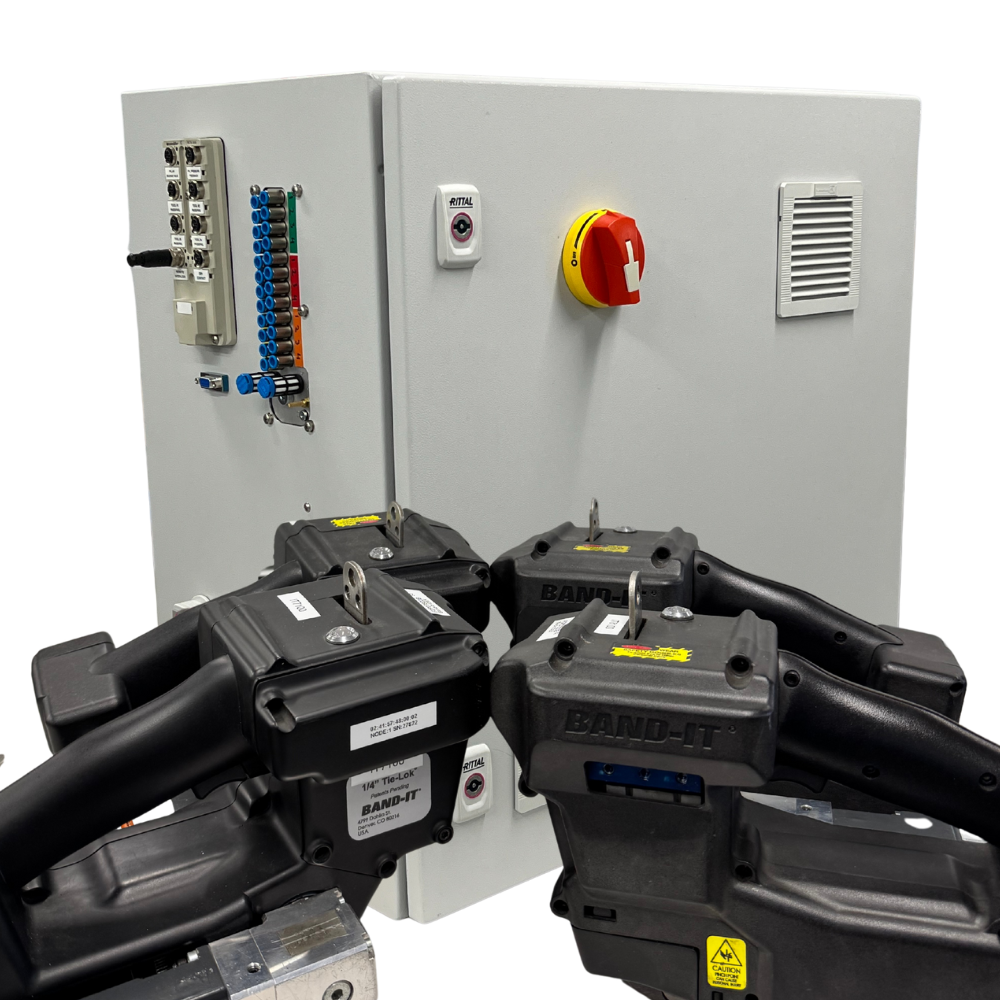
Coming soon, the new BAND‑IT PLC Multi‑Tool will exemplify this concept. It will allow up to four IT7100 or IT8100 tools, or up to 3 iCS tools, to be operated through one controller, which reduces variation between stations and supports consistent installation torque. This setup will also lower the equipment footprint and help production teams meet throughput goals without compromising quality.
Creating a Repeatable Fastening Strategy
Achieving true repeatability takes more than accurate tools. It requires a process built around control, verification and ergonomics.
1. Standardize the Setup – Use identical tool parameters across all lines to reduce variability.
2. Validate Regularly – Incorporate calibration and fastener fatigue testing into maintenance routines to maintain compliance with IATF 16949 documentation requirements.
3. Train for Consistency – Operator technique should be as standardized as the tools themselves, especially in high-volume applications.
4. Document Performance – Traceable data supports quality audits and ensures each fastening operation meets specification.
Applications Where Repeatability Matters Most
Airbag modules and steering systems rely on predictable performance to maintain safety. The Dual-Lokt® clamp is one example of a fastening design engineered for strength and precision, supporting consistent tension during installation. When combining the PLC Multi-Tool (coming soon) and the iCS tool, it will provide the repeatable results needed for high-volume, safety-critical production environments.
For teams evaluating how to use a production tool in validated processes, understanding tool control is essential for reducing variation and ensuring traceability.
What This Means for Your Production Line
Repeatability is not just an engineering goal; it is a safety requirement. For Tier 1 and Tier 2 suppliers, building consistency into fastening processes safeguards compliance, improves productivity and ensures confidence in every installation. As automotive manufacturing continues to evolve, controlled tool systems and validated processes will remain essential for performance and trust.
To learn how BAND-IT can help improve consistency and reduce variation in your fastening process, contact our team to discuss your application needs.