

Battery Bundling That Balances Strength and Space
May 13.2026 | Essential Applications
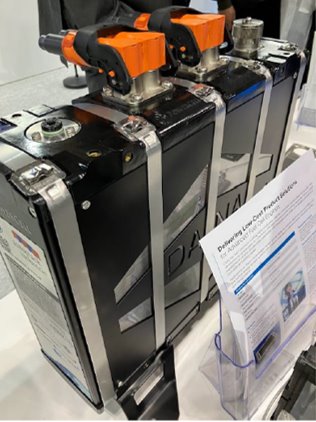
As battery systems scale in size and complexity, the way they are bundled during assembly has a direct impact on performance and production consistency. Modules must stay aligned, compression must be controlled, and installation must be repeatable across every build.
This challenge is becoming more important as electrified platforms grow worldwide, with strong momentum in Asia and increasing adoption across the United States and Europe.
For engineers and manufacturing teams, the question is not just how to bundle assemblies, but how to do it in a way that supports consistent results while maintaining space efficiency and enabling production validation.
Why Bundling Matters in Electrified Applications
Battery modules and fuel cell stacks rely on stable, uniform retention to perform as intended. Movement inside the assembly can lead to wear, misalignment or contact with surrounding structure.
Effective bundling supports several key needs:
- Maintains consistent spacing and alignment across the stack
- Helps prevent shift, abrasion or unintended contact within the enclosure
- Supports dimensional stability in systems where compression is required, including fuel cell assemblies
In dynamic environments, bundling must also account for vibration, thermal expansion and repeated start-stop conditions over time.
These requirements go beyond basic fastening. They call for a solution that can apply controlled compression and maintain it without adding unnecessary bulk.
Why Stainless Steel Banding Is a Strong Fit
Stainless steel banding offers a different approach compared to more rigid or application-specific retention methods.
It delivers high tensile strength in a narrow profile. This allows engineers to secure assemblies without consuming valuable space that could otherwise be used for energy capacity. In dense battery packs, even small gains in packaging efficiency matter.
Material performance is also important. Stainless steel provides corrosion resistance across a wide range of environments and maintains performance over long service intervals. Compared to polymer straps or adhesive-based methods, it offers a more durable option for systems exposed to heat, vibration or handling stress.
When required, coated band and compatible tools can be used to meet specific insulation or non-conductivity needs within the assembly.
Ultra-Lok Banding and DT1000 for Controlled, Repeatable Bundling
BAND-IT brings these advantages together through the Ultra-Lok® banding system and DT1000 digital tool, as well as 3/8″ Tie-Lok® with the IT8000 tool for battery bundling in production environments.
Ultra-Lok banding system:
- Uses 1/4 hard 201 stainless steel for high strength
- Designed for high clamping force with a gap-free inside diameter
- Can be double wrapped to support higher compression when needed
- Designed for use with the UL4000-D tool to support consistent and repeatable installation
DT1000 digital tool:
- Used with a PPA-coated band for applications requiring insulation or non-conductivity
- Allows operators to set a precise target tension
- Confirms that the correct tension was achieved during installation
- Captures and exports installation data for traceability
This level of control supports consistent results across production lines while providing documentation that many OEM programs now expect.
Together, these capabilities support repeatable compression and verified installation, which are critical in high-volume manufacturing environments.
3/8″ Tie-Lok Banding and IT8000 for Verified Installation
For battery bundling applications that require production-level validation and traceability, 3/8″ Tie-Lok banding paired with the IT8000 tool provides an additional solution.
3/8″ Tie-Lok banding system:
- Low-profile design suitable for compact battery assemblies
- Conforms to varying shapes and stack configurations
- Supports consistent retention across modules and pack designs
IT8000 installation tool:
- Supports verified installation for production environments
- Enables data tracking and export for process documentation
- Delivers repeatable installation performance across builds
This combination is well-suited for battery module assembly, where consistent installation and documented results are necessary.
Design Flexibility Without Added Bulk
Banding systems offer flexibility that can simplify both design and production.
They adapt to different stack sizes and geometric profiles without requiring a new hardware design for each variant. This can reduce part complexity and support platform-based development strategies.
Adjustable tension allows teams to fine-tune compression during assembly. It also enables rework during production.
Banding also supports serviceability, allowing assemblies to be adjusted or reinstalled without replacing the full retention system.
From a packaging perspective, the low profile minimizes obstruction around the assembly. This can help preserve airflow paths and cooling strategies that are essential in battery systems.
Banding can also support kitting approaches, where a consistent set of components and tools is used across multiple builds.
How Banding Compares to Traditional Retention Methods
Alternative retention methods often rely on rigid frames or application-specific hardware. While effective in certain designs, they can add weight, increase part count or require more complex installation steps.
Some approaches also limit flexibility when designs change or when multiple configurations must be supported.
Stainless steel banding offers a more adaptable option. It provides high strength in a compact form while allowing a single system to be used across different assemblies. For manufacturers, this can make it easier to standardize processes and reduce variation across production lines.
Where Stainless Steel Banding Is Being Applied Today
Battery bundling with stainless steel banding is already being used across a range of electrified applications.
This includes EV battery modules, off-highway systems and stationary energy storage. It also applies to backup power systems where space and reliability are key considerations.
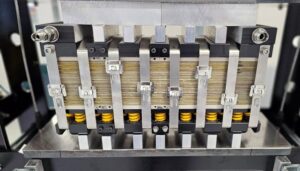
Fuel cell stacks represent an adjacent opportunity. While still developing in many markets, these systems share similar needs around compression and alignment, making banding a strong fit for pilot programs and production designs.
BAND-IT is being specified into leading OEM innovation programs in these areas, reflecting the shift toward more flexible and verifiable retention methods.
Moving Forward With Electrified Assembly Design
As electrified systems evolve, the balance between strength, space efficiency and production consistency becomes more important.
Stainless steel banding provides a practical way to meet these requirements without adding unnecessary complexity. With solutions like Ultra-Lok paired with the UL4000-D tool, DT1000 used with a PPA-coated band and 3/8″ Tie-Lok with IT8000, manufacturers can apply controlled compression and confirm installation results in a repeatable and verifiable way.
Talk with BAND-IT about banding solutions for electrified assemblies or explore digital banding tools for verified battery or fuel cell stack installation.