

Restraint Without the Tradeoffs: Rethinking Cable Cleats for Modern Power Installations
June 09.2026
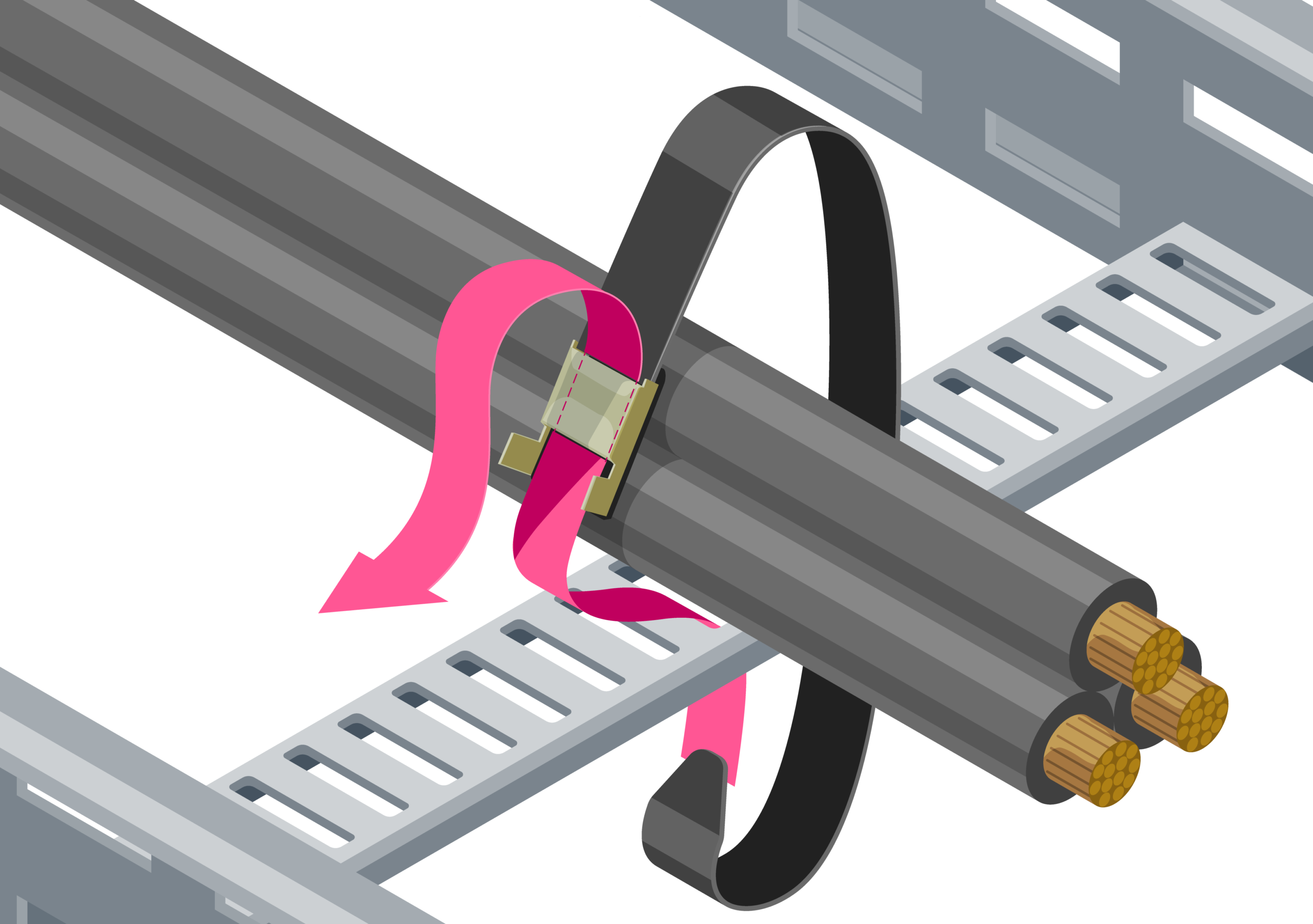
In high-fault environments, “secure and support” is not the same job as “short-circuit restraint.” Electrical designers and contractors already know the difference in the field; a neat bundle can still become a dangerous whip in a fault. The challenge is delivering compliant restraint without turning installation into a parts-staging exercise that slows cable pulls, burns crew hours, and creates rework.
That is where BAND-IT’s BAND-FAST® cable cleats separate themselves from both traditional multi-component cleats and traditional cable ties. The value is not a single feature. It is the combination of verified short-circuit performance, post-pull installation, fewer parts, and stainless-steel longevity that keeps projects moving while protecting equipment and people.
Restrain fault forces, don’t just ‘manage cables’
A cable cleat is designed to restrain power cables during short-circuit events, limiting movement driven by electromagnetic forces so cables do not collide, deform, or damage terminations. That definition is baked into the way cleats are tested under IEC 61914, which specifies requirements and tests for cable cleats (and intermediate restraints) used to secure cables in electrical installations, including declared resistance to electromechanical forces.
That distinction matters because fault forces escalate extremely fast. In practice, cable movement and jacket damage risk occurs in milliseconds, often well before protective devices clear the fault. BAND-IT’s short-circuit testing highlights how quickly damage can occur relative to breaker clearing times, which is why mechanical restraint is treated as a safety component, not a convenience accessory.
Why traditional cable ties fall short, even when they’re UL 62275 rated
Cable ties are a familiar and efficient tool for cable management, and UL 62275 rated ties continue to play a role where the requirement is organizing or supporting conductors. The limitation is not quality. It is what cable tie standards are intended to evaluate.
UL 62275 defines cable management, not fault restraint
UL 62275 covers cable ties and fixing devices used to manage, secure, or in some cases support wiring systems. The scope of the standard is clear that it does not evaluate mechanical protection of cables, including performance during short-circuit events.
UL’s application guidance for positioning devices explains cable ties primarily in terms of bundling and securement, with certain types evaluated for supporting cable weight. Declared loop tensile strength is used as a reference characteristic for these functions, not as verification of restraint under dynamic fault forces.
The NEMA technical bulletin on UL 62275 classifications reinforces this distinction. Even higher-rated cable ties such as Type 2S and 21S are differentiated by material performance and environmental durability, not by testing for axial or lateral restraint during short-circuit events.
Practical takeaway:
A UL 62275 listing supports code-compliant cable management and, where applicable, cable support. It does not verify short-circuit electromechanical restraint.
Material considerations over long service life
Nonmetallic cable ties are influenced by environmental factors such as UV exposure, temperature cycling, and moisture content. These effects are acknowledged in UL guidance and are appropriate for cable management applications.
BAND-FAST cable cleats take a different approach. Stainless steel construction and corrosion-resistant materials are selected for predictable mechanical performance and long service life in harsh-duty and mission-critical environments.
What this means in the field
When the requirement is simply cable management or basic support, UL-rated cable ties remain an effective solution. When the requirement includes verified short-circuit restraint, the selection criteria change.
Globally, cable cleats tested to IEC 61914 have become the common reference for managing electromechanical forces during fault events. That standard evaluates the failure modes cable ties are not designed to address.
As we’ve outlined in our cable cleat selection and application guidance, this shift reflects how global owners and designers are standardizing around performance-based verification, not just familiarity.
For engineers and contractors, the implication is straightforward. Matching the securing method to the mechanical risk improves safety, reduces rework, and supports long-term reliability as expectations continue to converge globally. In practice, cable cleats serve both roles required in high-fault installations. They keep conductors grouped in the intended formation and restrain movement when fault forces occur, which is the outcome installation codes are aiming to achieve.
Traditional cable cleats: compliant, but installation-heavy
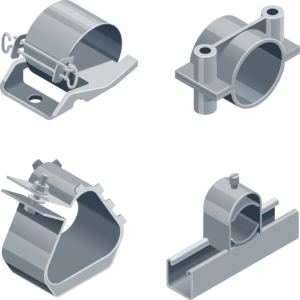
Many conventional cleat systems can meet standards, but the common pain point is not the performance during short circuit. It is the installation process, especially during cable pulling.
Cable pulling is already the critical path
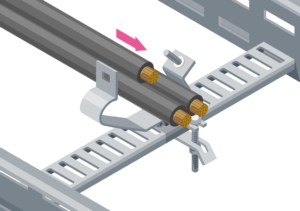
On large projects (data centers, industrial plants, offshore platforms), pulling single-core LV/MV feeders through tray and ladder systems is physically demanding. Multiple heavy cables are often pulled in parallel, and friction management is everything. Any obstruction in the tray can turn into a snag point that slows progress or risks cable sheath damage.
Why traditional multi-component cleats add “literal friction”
Traditional rung-mounted cleats often require hardware, brackets, and fixed-size bodies. That creates three recurring issues:
- Pre-staging before the pull: Many cleats must be positioned before pulling because they sit under the cable path and can interfere with rollers. That forces crews to predict cleat locations early and adds staging time.
- Pull-through friction and snag risk: Pre-staged hardware increases drag and creates snag points. Misalignment can slow the pull and complicate routing.
- Hard access after the pull: Once cables are in place and rollers removed, crews may need to reach under dense bundles to assemble and torque hardware in confined spaces. That is slow, fatiguing, and error-prone.
Installation effort compounds after the pull
Beyond cable pulling, traditional multi-component cleats introduce friction during the actual installation work itself. Crews are often assembling brackets, liners, washers, and fasteners in confined spaces under or around tray rungs, or within side channels running alongside them. That work frequently requires multiple tools, awkward reach angles, and precise torquing, all while working around fully populated cable trays. Not to mention the odd dropped washer or bolt, now rendering that assembly unusable.
In dense installations, this means installers are lifting and supporting heavy cables with one hand while aligning hardware and tightening fasteners with the other. The process is slow, physically demanding, and sensitive to access limitations, especially once trays are full and clear working space is gone.
Fixed sizes increase coordination and rework risk
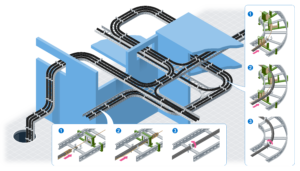
Fixed-size cleat bodies add another layer of complexity. Each cleat is typically designed around a narrow cable diameter range and specific formations. This requires close coordination between design assumptions, material staging, and field execution.
When cable diameters vary or routing conditions change, crews are forced to stop, verify sizing, or source alternate cleats. The result is added coordination overhead, substitution risk, and potential rework.
Even when a traditional cleat is fully compliant, multi-component, fixed-size designs can drive additional crew hours, coordination overhead, and schedule risk once trays are densely populated.
Restraint That Works With the Install, Not Against It
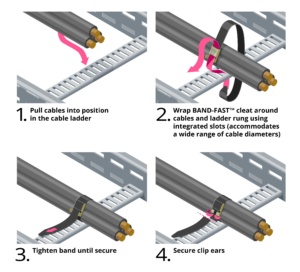
BAND-IT developed the BAND-FAST cable cleat system to address short-circuit restraint requirements without introducing installation friction that slows cable pulls, increases handling, or adds rework.
1) Verified short-circuit restraint aligned with global cleat standards
BAND-IT BAND-FAST cable cleats are certified to IEC 61914 for short-circuit restraint performance and are used in mission-critical applications where short-circuit restraint is treated as a mechanical safety function, not a secondary accessory.
The BAND-FAST system was intentionally developed to meet IEC 61914 restraint requirements without trading off installation efficiency, and that same discipline extends through the installation tooling so restraint performance is achieved consistently, not just in testing, but in real-world field conditions.
To support that consistency, BAND-FAST installations are paired with BAND-IT’s Digital Banding Tool platform, which allows installers to set and verify applied band tension. This helps ensure restraint performance in the field aligns with the assumptions used in testing and design, reducing variability between installations and crews.
2) Post-pull installation keeps the pull path clean
The core labor advantage is straightforward. BAND-FAST is designed to be installed after cables are pulled and aligned, keeping the pull path clear and protecting the critical path of the installation.
BAND-IT’s application guidance documents the challenges created by pre-installed cleat hardware during cable pulling and explains how post-pull restraint approaches reduce drag and simplify routing in dense tray installations.
BAND-FAST supports post-pull installation from multiple angles, eliminating pre-staging and reducing rework once cables are dressed and aligned. The Digital Banding Tool is designed to operate in constrained spaces common to high-density power installations, allowing controlled tensioning and cut-off without requiring additional clearance around the cable bundle.
Why contractors care: fewer interruptions during the pull, fewer snag points, and faster, repeatable lock-down once cables are in position.
3) Fewer components means fewer delays and fewer mistakes
Traditional cleat systems often require multiple brackets, bolts, liners, and size-specific bodies. BAND-FAST is designed to simplify that complexity, reducing parts handling in the tray and minimizing SKU burden through broad adjustability. Even in material handling, BAND-FAST packaging supports bulk transport, allowing installers to move large quantities of cleats efficiently. By contrast, traditional cleats are often shipped as individually packaged, partially assembled components with a significantly larger and less mobile footprint.
In hyperscale environments, this simplification is measurable. In a recent case study, contractors eliminated more than 80 percent of sizing and component selection effort compared to conventional cleats, while still meeting globally recognized performance expectations.
4) Measurable installation and cost advantages
Based on field use and published comparisons, BAND-FAST delivers:
- Installation up to three times faster
- Up to 75 percent lower material cost
- Low-profile geometry that supports dense tray routing
- Stainless steel, corrosion-resistant, LS/ZH construction for durability in harsh environments
These attributes translate directly into what project teams measure on site; crew hours, rework, tray congestion, and long-term reliability. Controlled, repeatable band tension also reduces rework and inspection variability, supporting consistent outcomes across crews, shifts, and project locations.
A standards trend you can’t ignore on global projects (and increasingly in North America)
Global builds often standardize above minimum local code so designs can be repeated across regions. In many cases, that standardization follows international test methods that later become embedded in regional requirements. For cable cleats, the center of gravity for performance expectations has long been IEC-led, with the rest of the world aligning around comparable electromechanical test criteria.
This pattern is not new in North America. A clear example is cable ties. The UL 62275 standard adopted IEC 62275 and established defined performance classifications for cable ties used in electrical installations. Over time, the expectation that cable ties used for support be listed and evaluated to that standard became widely accepted in U.S. practice, even though earlier codes relied on more general securing language.
In parallel, the intent of the NEC around controlling conductor movement under fault forces has been consistent. NEC 392.20(C) requires single conductors to be secured to prevent excessive movement due to fault-current magnetic forces, without prescribing a specific device.
More recently, the development of NEMA BI 50018-2024 provides another signal of convergence. Its scope specifies requirements and tests for cable cleats used to secure cables and retain them in formation within electrical installations, including resistance to electromechanical forces.
Canada has taken this one step further by adopting CSA C22.2 No. 61914:23 for cable cleats. That standard explicitly differentiates cable cleats from cable ties, noting that cable ties remain covered under CSA C22.2 No. 62275, while cleats are evaluated under a separate restraint-focused framework.
Design implication: For projects serving global owners or repeatable designs, specifying IEC 61914-tested cleats is increasingly the common language across regions, including North America, as expectations continue to move from general securing toward verified restraint performance.
Side-by-side comparison: BAND-FAST vs traditional cleats vs cable ties
BAND-FAST vs traditional multi-piece cleats
Where BAND-FAST wins:
- Faster installation: post-pull install, access from multiple angles
- Lower install friction: avoids pre-staging that can interfere with rollers and pulls
- Fewer components: less handling in confined trays, less chance for missing parts
- Broad adjustability: reduces size-specific cleat SKUs
BAND-FAST vs traditional cable ties (including UL 62275 ties)
Where BAND-FAST wins:
- Short-circuit restraint purpose and test basis: cleat performance is verified under IEC 61914, while UL 62275 does not evaluate mechanical protection of cables provided by ties
- Long-term durability in harsh environments: stainless steel, corrosion resistance, LSZH construction
- Engineered to restrain, not just bundle: cable ties are positioning devices for bundling/securement, with support only in certain configurations and declarations
Applying restraint requirements in design and installation
In practice, restraint performance is driven by a small set of inputs that engineers already work with every day: available fault current, cable formation (trefoil or flat), cable diameter, cleat spacing, and the mounting structure. These variables define the forces a restraint system must manage and are the basis of IEC 61914 testing and selection guidance.
BAND-IT’s cable cleat calculator is available to support this process, allowing project teams to evaluate cleat selection and spacing against key inputs such as fault current, cable formation, and installation geometry.
On the installation side, protecting the schedule means focusing on the work that actually sits on the critical path:
- Keep the pull path clean: avoid pre-staged hardware where tray density is high
- Secure after alignment: post-pull restraint reduces rework and awkward access under dense bundles
- Standardize where possible: fewer SKUs and fewer components reduce pick errors and handling time
BAND-FAST was developed around these realities, aligning restraint performance with how systems are designed, pulled, and secured in the field.
Where restraint performance and installation reality meet
Across global power projects, expectations around cable restraint are becoming more consistent. Engineers and owners are increasingly looking beyond general securing language toward solutions that are verified for the forces that actually drive cable movement during fault events. At the same time, installation efficiency remains a critical constraint, especially in dense tray systems where labor, access, and rework directly affect schedule.
That tension between restraint performance and constructability is where BAND-FAST was developed. By aligning IEC 61914 short-circuit restraint requirements with post-pull installation, simplified components, and dedicated tooling, BAND-FAST is designed to support both how systems are engineered and how they are built in the field.
For project teams working across regions or supporting global owners, this approach helps reduce variability without adding complexity. Restraint performance is verified, installation friction is minimized, and outcomes remain repeatable across environments.
To discuss how BAND-FAST can be applied on a specific project, including cleat selection, spacing, and installation approach, contact the BAND-IT technical team or use the BAND-IT cable cleat calculator to support early design decisions.
FAQ
What is the difference between a cable cleat and a cable tie?
A cable cleat is a mechanical restraint device intended to hold power cables in position during short-circuit events, with performance verified under standards like IEC 61914:2021.
A cable tie under UL 62275 is a cable management/positioning device used for managing, securing, or supporting wiring systems, and UL 62275 explicitly does not evaluate mechanical protection of cables provided by the tie.
Why does post-pull installation matter?
Traditional cleat systems often require pre-installed hardware that can increase friction and snag risk during cable pulls. Post-pull systems let crews pull and dress cables first, then secure them, reducing drag and improving access in dense trays.
Is UL 62275 enough for short-circuit restraint?
UL 62275 addresses cable ties used for management, securement, and in some cases support. It explicitly does not evaluate mechanical protection of cables, which is central to short-circuit restraint.
What standards are driving cable cleat adoption globally?
IEC 61914:2021 defines requirements and tests for cable cleats, including declared resistance to electromechanical forces.
In North America, broader alignment is reinforced by NEMA BI 50018-2024 (cable cleat test scope) and Canada’s CSA C22.2 No. 61914:23.