

The Hidden Schedule Risk in AI Data Centers: Why Cable Restraint Is Now a Critical Path Decision
June 29.2026
AI Infrastructure Is Redefining What “Fast” Means
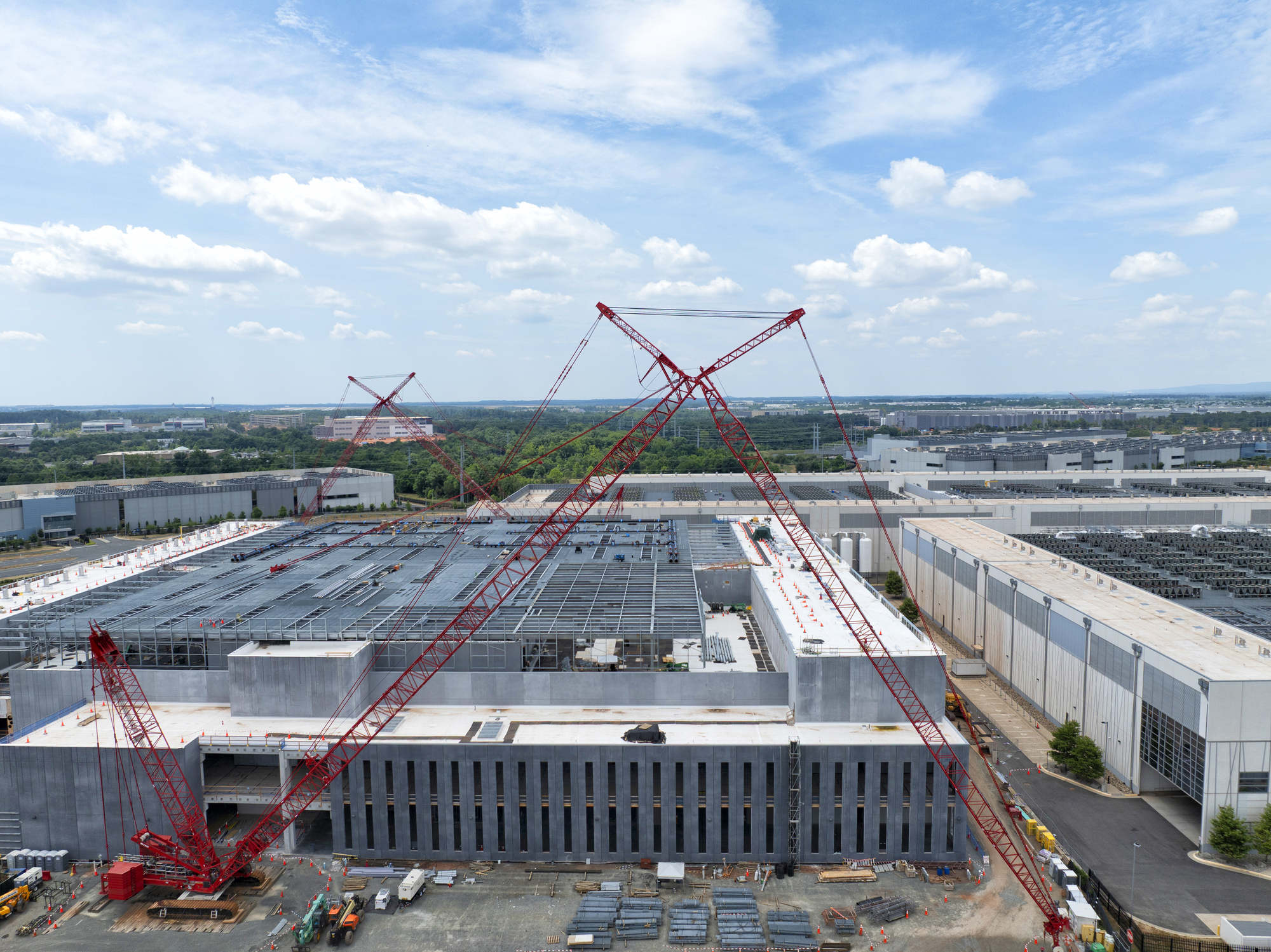
AI-driven workloads are reshaping how mission-critical projects like data centers and semiconductor facilities are designed and built. Power demand is rising rapidly, rack densities are increasing, and electrical systems are scaling in both size and complexity. According to VC Chamath Palihapitiya, it now costs up to 20x as much to build 1GW compared to a few years ago.
But the real shift is happening on the construction side.
Schedules are compressing while scope continues to expand. Projects that once progressed in defined phases now require parallel execution across multiple trades, systems, and work zones. In these environments, success is no longer defined by design alone. It is defined by how efficiently systems can be installed, adjusted, and completed in the field.
This is where a critical gap is emerging.
The Industry Is Focused on Power. Execution Is Becoming the Bottleneck.
Much of the industry conversation today centers on power availability. That focus is valid, with data centers requiring more power than ever before, making securing that capacity is a major challenge.
However, a second constraint is becoming just as important. Across the industry, that constraint is increasingly being described as execution capacity. In highly repetitive, schedule-critical environments like data centers, contractors are finding that delivery speed per labor hour, not just total labor availability, is becoming the defining limit on project timelines.
The limiting factor is increasingly how quickly that power can be installed, routed, and secured once it arrives on site. Recent coverage of AI infrastructure buildouts reinforces this shift. Even where capital and power are available, projects are increasingly delayed by constraints in skilled trades and field execution, particularly among electricians and high-voltage installation teams.
This is especially true in cable-based distribution systems common in data centers, chip fabrication facilities, and other AI-related infrastructure. These systems rely on large volumes of exposed conductors routed through tray and ladder systems. While this approach provides flexibility and scalability, it also introduces a new set of challenges during installation.
Cable restraint sits directly in the middle of this challenge. It is required for safety and compliance, particularly under short-circuit conditions. That combination makes it a potential critical path driver.
Why Cable Cleats Are Replacing Cable Ties in Critical Power Runs
Before looking at how cable restraint impacts installation, it’s important to recognize a broader shift happening upstream in design and specification.
Across data centers, chip fabrication facilities, and other high-energy electrical builds in the Americas, developers and tenants are increasingly specifying cable cleats for critical power runs rather than relying on nylon cable ties. This change is being driven by higher fault current levels, larger parallel conductor installations, and a growing focus on mechanical restraint in open tray systems where cables are exposed to short-circuit forces.
As power densities rise, restraint is no longer viewed as optional cable management. It is being treated as a defined part of the electrical design.
For a deeper look at where and why cable cleats are being specified in modern data centers, see our article: Why Mechanical Cable Restraint is Becoming a Global Baseline.
Why Cable Restraint Has Moved Onto the Critical Path
Traditionally, cable cleats are often installed before the cable pull begins. This requires crews to pre-stage hardware, determine spacing ahead of time, and install components inside the tray before conductors are routed.
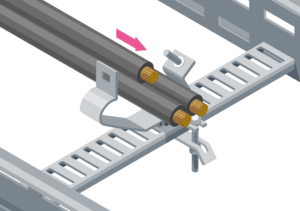
On paper, this approach appears straightforward. In practice, it introduces friction into the cable pull itself. Hardware placed inside the tray can interfere with rollers and pulling equipment. Crews must work around fixed locations that may not perfectly align with real-world routing conditions. Adjustments during or after the pull add time and increase complexity. In high-density environments, these issues compound quickly.
Cable restraint is no longer just a step in the process. It directly impacts the sequence of installation when cleats are involved. If the system does not align with how cable is physically installed, it slows everything that follows.
System Complexity Creates Coordination Risk
Traditional cleat systems often rely on multiple components:
- Cleat bodies sized to specific cable diameters
- Mounting brackets or base hardware
- Rubber channel or cushioning materials
- Fasteners or drilled attachment points, often requiring torquing
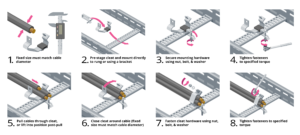
Each additional component introduces a dependency. Materials must be ordered correctly, delivered on time, staged appropriately, and matched to the exact configuration on site. In fast-moving projects, that level of coordination creates risk. If trays arrive without the expected perforations, drilling may be required. If brackets do not match the configuration, adjustments must be made in the field. If the wrong cleat size is staged, crews are forced to improvise or wait. These issues are not always visible in design documents, but they show up immediately during installation. Every additional component in a cable restraint system becomes another potential point of delay.
The Gap Between Specification and Execution Is Widening
Specifications typically define what should be installed. Field conditions determine what actually gets installed. As project complexity increases, that gap is growing. Material availability continues to fluctuate, with many projects seeing extended lead times on critical electrical materials such as medium-voltage equipment, forcing changes in routing, design assumptions, and installation sequencing to keep schedules intact. Cable types, tray systems, and routing conditions change as projects evolve. Design intent often meets real-world constraints that require fast decisions to keep work moving. In this environment, field teams prioritize solutions that can be installed quickly, consistently, and without excessive complexity.
This is not a rejection of standards or safety requirements. It is a reflection of how modern projects are executed. Execution and getting the job done are increasingly driving RFIs and revisiting specifications, often influencing decisions around ultimate material selection. If a solution is difficult to install under real conditions, it introduces risk regardless of its theoretical performance.
When Small Frictions Become Schedule Impact
On a typical data center or semiconductor build, cable restraint points can number in the tens of thousands.
- Additional time per installation accumulates across crews and shifts
- Rework caused by misalignment or access limitations spreads across multiple runs
- Missing or mismatched components delay entire sections of work
What begins as a minor installation detail becomes a measurable schedule impact.
At the project level, those impacts can be significant. Industry analysis shows that delays in delivering or commissioning data center capacity can translate into substantial financial losses, with one study estimating $14.2 million in lost revenue for every month delayed, reinforcing the need to eliminate avoidable inefficiencies during construction.
A Shift Toward Execution-Aligned Cable Restraint
To address this challenge, the industry is beginning to shift toward cable restraint solutions that align with how installations actually occur in the field.
- Installation after cable routing is complete
- Minimal components that reduce staging complexity
- Flexibility across cable sizes and configurations
- Compatibility with tight spaces and dense tray environments
- Reduced dependence on tray modification or additional hardware
This shift reflects a broader change in how infrastructure is evaluated, with the focus moving from theoretical performance to practical execution.
What Contractors and Project Managers Are Prioritizing
Across data center and semiconductor projects, several priorities have become consistent:
- Speed of installation: Crews must complete large volumes of work under tight schedules, with short notice
- Material availability and reliability: Delays in supply chain can impact entire project phases and drive significant material selection & design changes
- Simplicity and repeatability: Systems must work across multiple crews with minimal variation
- Flexibility in the field: Solutions must adapt to changing conditions without requiring redesign
In many cases, cost is no longer the primary driver. Schedule certainty and execution reliability take precedence. This is especially true in AI infrastructure, where delays in bringing capacity online carry significant downstream impact.
Aligning Cable Restraint with Modern Construction
BAND-IT’s strap-style cable cleat solutions are designed around these realities.
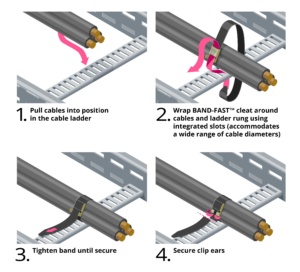
Rather than relying on multi-component assemblies, these systems use a simplified approach:
- Direct-to-tray or rung installation without brackets
- PPA-coated designs that eliminate the need for rubber channel in many applications
- Post-pull installation that avoids interference with cable routing
- Cross-wrap (NEW!) capability that supports installations even when tray perforation is limited
- Reduced SKU complexity for easier planning and staging
This approach aligns cable restraint with how electrical systems are actually installed in high-density environments. By reducing components and enabling installation after cables are in place, crews can maintain pulling efficiency while still achieving compliant restraint. In high-volume installations, removing even one component from the process can eliminate thousands of individual steps across a project
The result is not just faster installation. It is more predictable execution.
Looking Ahead
As AI infrastructure continues to scale, electrical systems will only become more complex. Higher power densities, tighter spaces, and faster project timelines will place increasing pressure on installation methods.
In this environment, components that were once considered minor details are taking on greater importance.
Cable restraint is one of them.
It plays a direct role in safety, but it also influences how quickly and reliably projects can move from design to operation.
For electrical contractors, engineers, and project teams, the takeaway is clear: cable restraint can no longer be treated as a downstream detail. It needs to be considered early, specified with execution in mind, and aligned with how work actually gets done in the field.
To see how execution-aligned cable restraint solutions can help reduce installation friction and support faster project delivery, explore BAND-IT’s cable cleat solutions or connect with our team to discuss your next build.